The Seasons of Parenting: Fresh Ideas to Ease this Back-to-School Season

Oversubscribed Newsletter
Season Q4: 2026
Back to School
Article by Megan Hughes, PhD
In our Q3 Summer 2026 newsletter, we mentioned how working parent schedules can often change in the summer. While at times that means a slower pace, it can also mean a more chaotic one. For me, this summer has definitely been more chaotic. We had a busier travel schedule than usual. I'm planning an office move for the end of August and anticipating a middle school transition. And, we’ve decided to invite in the ultimate source of chaotic good energy…a puppy! As I’m staring down an unusually busy fall and getting a bit nervous about how it’s all going to come together, I’ve pulled some of my favorite back-to-school season resources to share with other working parents who might also be experiencing some overwhelm.
First up: Kelly Nolan’s Back-to-School Guide to catch all your back-to-school to-dos.
Kelly Nolan is a working mom who has the greatest tips for productivity and keeping track of *all the things* especially for parents with kids in the school-age years. She has a downloadable Back-to-School Guide that lists what you’ll want to remember to do in anticipation of the new school year. You won’t need to do every item on the list, but I guarantee you’ll see some things there (for example, schedule that back-to-school haircut) that you may not have thought to plan in advance. She also recommends that you take note of items that fell through the cracks last year so that you can add them as a recurring calendar event going forward…and you’ll never miss them again.
Check out her Back-to-School podcast episode from last year for another great resource. In it, Kelly suggests calendaring time for emotions. Basically, if you know your child has a hard time with transitions, then give yourself extra time in your schedule in the morning for the first few weeks of school. It’ll be easier to stay calm during a tough drop off if you aren’t worried about running late for your first meeting of the day.
Another genius idea she has is to calendar a time in the future to check in about a problem that is arising now. For instance, I’ve spent a day worrying about a kid situation at drop off that had been completely resolved by pickup. Kids are often more resilient than we think, and a problem that seems huge one day may have resolved itself by the next day. So, if something comes up that you think you’ll need to address with a doctor’s appointment, a therapist, or a call to the school, put it on the calendar for a few days or a few weeks in the future. Allow yourself to observe if anything arises related to the problem. And when the calendar reminder pops up, if it still needs to be addressed, then definitely go forward and address it. If it’s no longer an issue, you don’t need to do a thing…and you didn’t spend a week worrying about it.
Second Tool: Gretchen Rubin’s Four Tendencies to help yourself (and your kids) meet work and school expectations.
Gretchen Rubin’s Four Tendencies concept has been really helpful for me. The Four Tendencies describe how people tend to respond to inner expectations (I want to exercise today) and outer expectations (I have a work project due to my boss today). Upholders tend to respond to both inner and outer expectations and find it pretty easy to get things done. The rest of us need a more nuanced approach. Questioners need to be convinced that an external expectation makes sense for them. Obligers find it easy to meet external expectations but harder to meet their inner expectations. Rebels may resist all expectations.
Here’s a summary of Gretchen Rubin’s Four Tendencies and tips for getting things done based on one’s tendency:
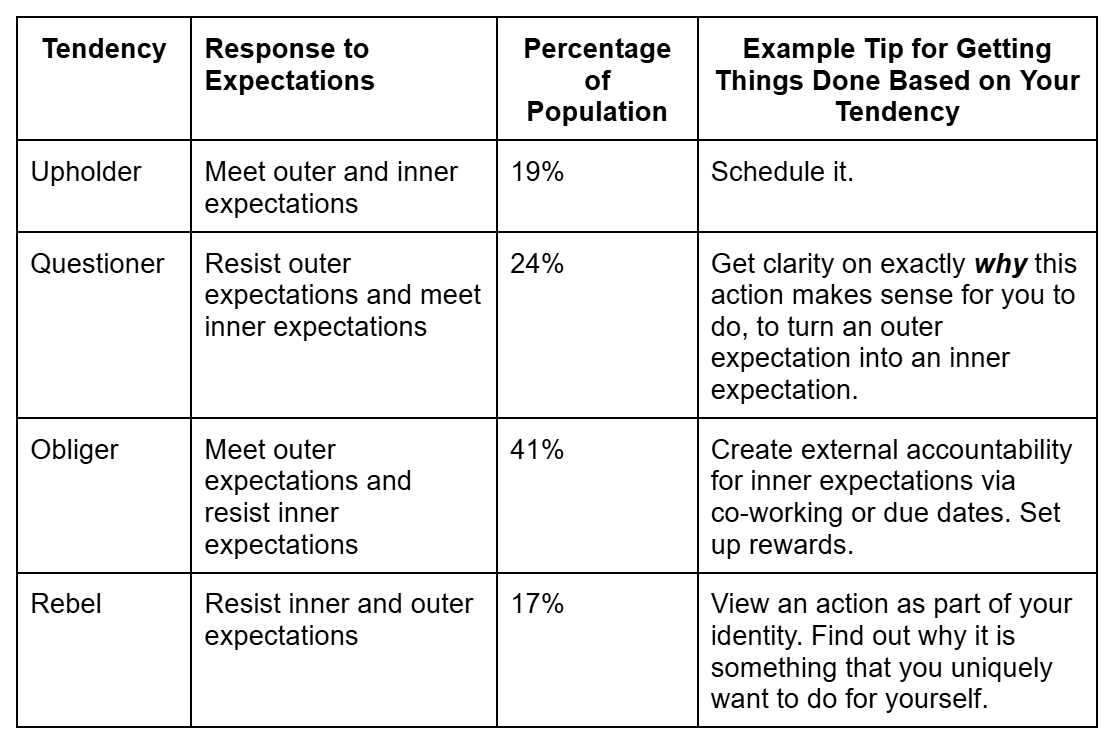
Summary of Gretchen Rubin’s Four Tendencies
The largest group of people are Obligers, who tend to meet outer expectations while struggling with inner ones. An example that demonstrates my own Obliger nature is how I responded to a switch from outer to inner expectations with paperwork. When I worked within an academic medicine department, there was a strict 24-hour paperwork rule. I always met that deadline. When I switched to private practice, there was no longer an external rule about paperwork time and my turnaround time increased. For me to get my paperwork done on time, I had to make it an external obligation again by creating co-working times and accountability with other colleagues.
How would people with the other tendencies have responded to the same situation? An Upholder, Questioner, or Rebel’s paperwork habits may not have changed when an expectation switched from external to internal, but for very different reasons. An Upholder responds to inner expectations with equal weight to external obligations, so they’d continue completing their paperwork in a timely manner. A Questioner would keep the 24-hour rule if they’d already convinced themselves that the rule made sense for them (thus having made the expectation an inner one). A Rebel would only maintain the habit if it had aligned with their personal identity–or they may not have been meeting the deadline to start with.
You can take a quiz to identify your tendency. It can help you get a sense of how you tend to respond to expectations and then apply tips that will help you to meet them. Here is also a podcast episode in which Rubin focused on the Four Tendencies. And you can check out Rubin’s article on helping your kids understand how to apply strategies to help them complete their schoolwork in the new year, based on their tendency. For more in-depth tips on how to manage your tendency, see this article or Rubin’s book on this topic.
Third Tool: Cal Newport’s advice on how to take a pause when you are feeling stuck.
If you are feeling stuck in an area of your life, I’d invite you to listen to Cal Newport’s podcast episode, “Should I Press Pause?” In this episode, he talks about several levels of taking a pause to get unstuck from a work (or life) problem.
Newport begins with identifying the function of a reset. He suggests that finding protected time for a reset can help a) reduce the constant context shifting of a typical workday, b) introduce a fresh new physical space which can be a source of new ideas, and c) escape the typical daily routine in order to make space for future-oriented thinking.
Pick the Size of Your Pause: In light of the fact that we can’t usually drop everything to attend a luxury wellness retreat, Newport offers opportunities to create a small, medium, large, or extra-large pause. Depending on your circumstances, choose the tier that fits best.
Level 1: Get up early and go for a walk to somewhere familiar (e.g., your typical coffee shop) but at an earlier time than you’d normally go. Time commitment is under an hour.
Level 2: Schedule a morning or afternoon away from work. Take a full shutdown of work tasks, leave your phone at home, and go somewhere new with a journal. Time commitment is 2 hours.
Level 3: Schedule one night away in an unfamiliar place that is a few hours away. Time commitment is 24 hours.
Level 4: Fly somewhere new and have a full multi-day retreat. Amazing if you can pull it off.
What To Do During Your Pause:
Newport suggests starting with journaling about what is going well before diving into what is feeling stuck. Once you start thinking about the area of stuckness, he suggests coming up with the most radical option for changing things (e.g., quit and join the circus). From there, you progressively reduce the radical nature of the proposed change until you hit on something that is the least radical change that could actually solve the problem. You’ve found your new idea!
Implementing Your New Idea:
When you come back from the pause, discuss with a partner, family, colleagues, or any stakeholders you trust to think through your new idea. Pick a specific action that can address the stuck feeling and take the first step.
I often turn to tools from Kelly Nolan, Cal Newport, and Gretchen Rubin when I’m hoping to level up my planning. If this back-to-school season is feeling a little intense for you too, give one of these a try. I’d love to hear how it goes!